Introduction by Example
Welcome to the introduction of gflownet, a library designed to facilitate training and extending Generative Flow Networks (GFlowNets) for a wide range of applications, especially in scientific discovery. GFlowNets provide a framework for probabilistic and generative modeling.
What are GFlowNets?
Generative Flow Networks, or GFlowNets, are a type of generative model that sample objects \(x \in \mathcal{X}\) proportionally to a reward function \(R(x)\). This framework is particularly suited for applications where the goal is to generate diverse high-reward samples, such as in scientific discovery.
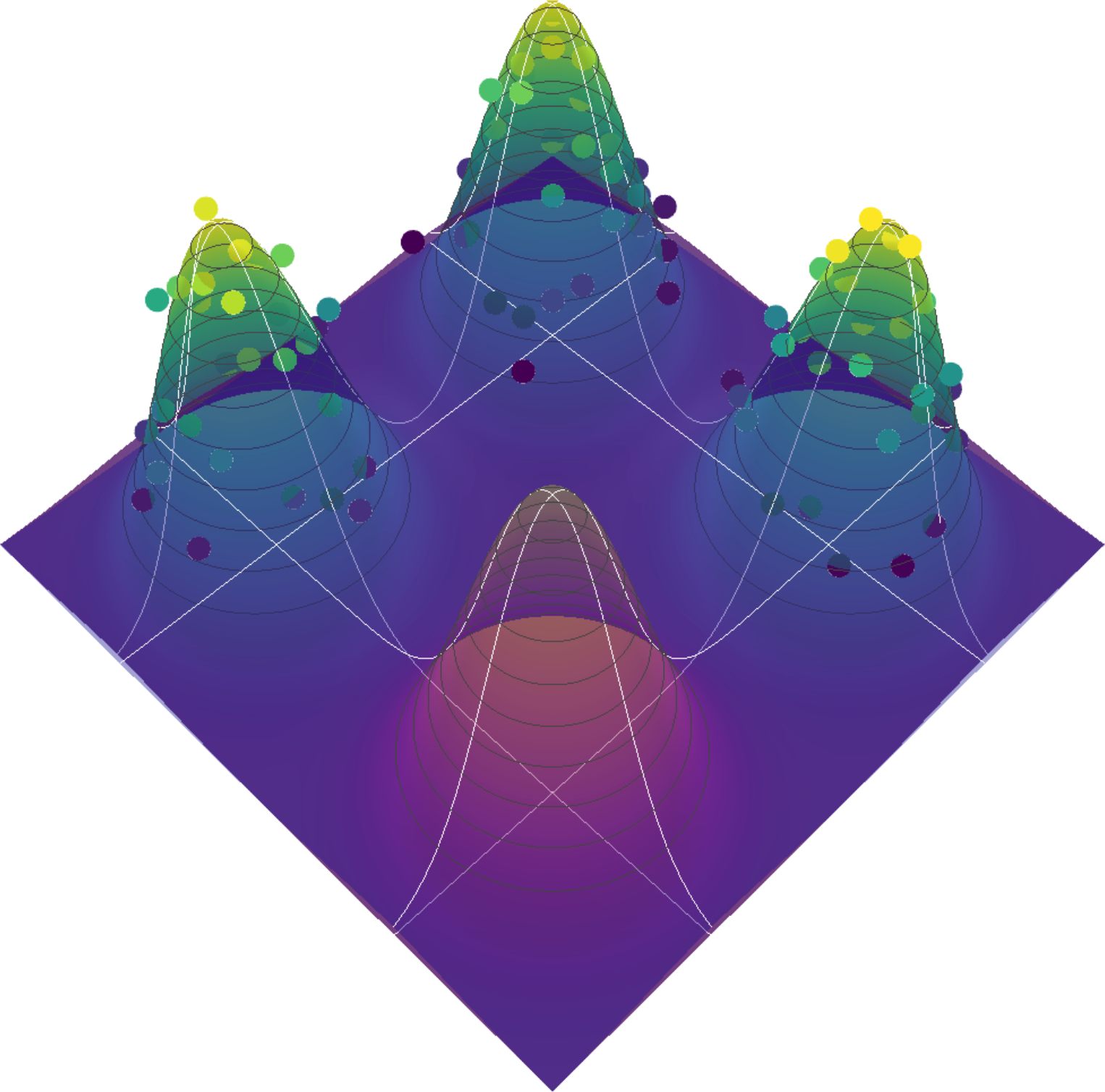
The model learns to transition between states in a way that the frequency of generating any given state is proportional to its reward. For instance, a GFlowNet trained on a 2D space with four high-reward areas would learn to sample those areas more frequently.
Compositionality and Sampling
GFlowNets utilize compositionality by decomposing samples \(x\) into sequences of intermediate states, such as:

In the example of generating Tetris-like boards, each board configuration is built by adding one piece at a time, starting from an empty board. Each intermediate state has potential “parents” and “children,” forming a directed graph over states, where each edge (transition from one state to another) is modeled and learned.
Key Components
gflownet comprises several core components essential for its operation:
Environment: Defines the state and action spaces for tasks, such as the Tetris or Scrabble environments.
Proxy: Manages the reward function logic, essential for evaluating states.
Policy Models: Neural networks that model the transitions between states.
GFlowNet Agent: Orchestrates interactions between the environment, policies, and proxy, among other functions.